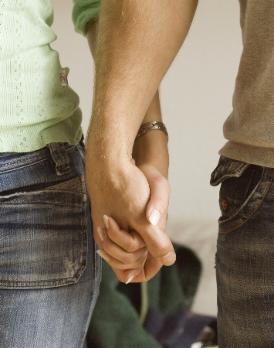
A good relationship as the foundation for a good life
Health and well-being
We
all know how dramatically a distressed relationship or marriage can
constrict one's quality of life. Intuitively we have always known that a
good
relationship is the foundation for a meaningful and fulfilling life.
Today
there are scores of scientific research findings supporting this ancient
wisdom. We know
for example that emotional isolation poses an equally high health risk
as
does smoking or obesity. This is not surprising as it has been
demonstrated
that relationships affect even immune system functioning and wound
healing. So
investing in building a good relationship might be equally important as a
healthy diet and regular exercise. Similarly, studies have found that
in a happy
relationship the presence of your partner can actually lessen the
intensity of
fear and pain. We also know that if you can find comfort in the arms of
your
partner, the negative impact of traumatic life events on your
psychological
health is minimized dramatically. After reviewing the research available
on this matter, the
social psychologists Roy Baumeister and Mark Leary concluded that to
human
beings relationships are as important for well-being and survival as is
food and
water.
Boosting self-worth
Even our sense of self-worth depends on the quality of
our intimate relationships. In our culture, which prizes individualism, we often
think that we are solely responsible for our own sense of self-worth. Many
psychologists even suggest that positive thinking and will power is all that is
needed to achieve a stable sense of self-worth. But when it comes to shaping
how we feel about ourselves, reality is a much stronger force than our thoughts
or our own will power. More often than not, in reality our sense of self-worth is an
accurate reflection of how much love, care and acceptance we experience in our
most important relationships. When we are rejected by our loved ones, we
naturally start doubting ourselves. A wise man once said that you can
accomplish anything on your own, except sanity.
Antidote to pain and platform to fly from
Loneliness
and distress in relationships amplify
life’s problems and pain. A loving relationship is the ultimate antidote
against the fear and pain that we will inevitably encounter in life.
Together
we can better master the storms of life and life’s problems become much
smaller. Together we can experience life’s obstacles as challenges that
stimulate us, rather than as problems which wear us down – we can live
life from
a place of vitality, energy, curiosity and joy. A strong relationship
gives us
a secure base – a platform we can fly from and a place we can return to
whenever we need comfort, care, support or acceptance. In a strong
relationship
both partners feel supported in pursing their own interests, values and
life
goals and can be more fully who they really are.
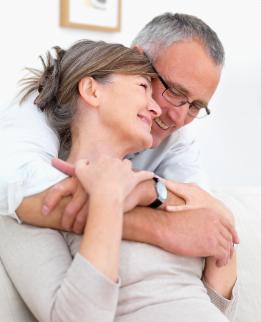
Is couple therapy the right thing for us?
Many good reasons

Why do we get stuck in misery and distress, and why is it so hard to get unstuck by your own efforts alone?
Vicious cycles
When
partners fall in love with each other, we see
this process where both partners take small steps towards each other.
Step by
step each partner reveals a new aspect of him- or herself to the other.
As long as this process continues, trust and intimacy flourish. But then
something happens and the partners decide that they need to start
protecting themselves
instead of opening up to their partner. This is where vicious cycles of
distress start. Often we are not aware of what has happened until we are
already caught
in a cycle and we can no longer recall what triggered it. Often triggers
are
misunderstandings, stressful life situations in which one partner cannot
be as
present and available to the other as before, and fears that partners
have
brought into the relationship from their pasts. The trouble with those
vicious
negative cycles is that they are very compelling – they exert a pull
that is
hard to resist. Ironically, this compelling nature is due to a very
positive
thing: The compelling nature of negative cycles is due to the fact that
partners
have a huge impact on each other – usually the impact we have on our
partner is
much larger then we realize. So, if one partner protects him- or herself
by
getting angry or withdrawing, that has a huge impact on the other, and
so he
or she quickly moves to protect him- or herself as well. Vicious cycles
of
interaction develop a life of their own and they tend to take over you
and your
relationship. After a while, these cycles are so quick and so compelling
that it is hard
to escape from them without the help of a skilled therapist. Below,
under the heading "How does Emotionally Focused Couple Therapy work?" you will find more information about vicious cycles.
No model

The goals of couple therapy
Secure relationship
Different methods of couples therapy have different goals. The method I practice is called Emotionally Focused Couples Therapy. The goal of Emotionally Focused Couple Therapy is not only the reduction of fights, tensions and negativity. The main goal of Emotionally Focused Couple Therapy is to create a secure relationship. What is a secure relationship? A secure relationship is a relationship in which both partners feel accepted for who they are and in which they find closeness and comfort with each other whenever they need it. It is also a relationship which supports both partners in pursuing their own goals and dreams and in becoming more of who they really are.
Passion and sex
A secure relationship is also the prerequisite for passion and great sex. For only if I feel accepted and safe in a relationship, can I freely express myself and take the risks involved in passionate sexuality. How can I feel turned on when I feel tensed all the time because my partner is angry or emotionally distant and shut down most of the time? As they say, porcupines have to make love very carefully. The same holds true for humans when one's partner is angry or resentful and looks as prickly as a porcupine. In a secure relationship partners can have passionate sex because they can let go, and there is room for spontaneity and for allowing themselves to be carried away by the wave of passion.
Quick reconciliation A secure
relationship is not a “perfect”
relationship. Human beings are not perfect, so
we cannot expect our relationships to be perfect. And the good news is
that
perfection is not even necessary: If we take a look at research studies,
we can see that secure and insecure relationships do not so much
differ in the number of conflicts. Both happily and
unhappily married couples have conflicts. A major difference is that in a
secure relationship conflicts are resolved quickly, while in an insecure
relationship conflicts are extremely stressful and prolonged. In a
secure
relationship conflicts are like a cool breeze on an otherwise warm and
sunny
day. In an insecure relationship, in contrast, conflicts often lead to
fierce arguments,
prolonged emotional disconnections, and intense feelings of hopelessness
and isolation.
In secure relationships repeated experiences of emotional reconnection
after conflict lead to a strong sense of trust: When you know from
experience that
conflicts can be resolved, differences no longer feel so threatening.
Instead
differences can be experienced as enriching and exciting.

How does Emotionally Focused
Couple Therapy work?
Like a dance
Let
me introduce a metaphor to make this explanation
as simple as possible: In a way a relationship is like a dance. A
relationship and
a dance have in common that both partners move together, they react to
each other, and they move toward each other and away from each other in
particular ways. When we picture a
relationship as a dance, then emotions can be looked at as the music of
that
dance. In a dance the music makes us want to move in certain ways.
Similarly, in
relationships our emotions define the way we interact with our
partners. With the right type of music a dance can be exhilarating and
passionate. But with the wrong kind of music the dance either looks
clumsy or
boring or partners end up stepping on each other’s toes. A common dance
in a
distressed relationship looks like this: One partner (say Chris) feels
hurt or neglected and
so he or she gets critical or demanding in order to make his or her
partner
(say Ryan) respond. The more critical and demanding Chris gets, the more
Ryan feels attacked and moves away. And the more Ryan moves
away, the more Chris feels hurt and neglected, and the more
critical and demanding he or she becomes. This of course makes Ryan
move away even more and so a vicious cycle is created. The emotional
music in
this dance is typically anger, resentment and icy silence. Relationship
dances
tend to be vicious cycles that drive partners further and further apart
and
into distress, until love and passion are only faint and distant
memories. Of
course this is a quite simplified description of a "relationship dance",
in
reality relationships can be very complex (and confusing) indeed.
Stage 1: Understanding your dance
The
method of couples therapy that I practice has
three stages. In the first stage, I help partners recognize the "dance"
they have created together and how they end up stepping on each other’s
toes. I also help them see how their emotions motivate their moves in
this
relationship dance. Clearly seeing how they move together and how they
unintentionally step on each other’s toes already helps the couple do
less of
the toe-stepping. In other words, by gaining this new perspective on
their
relationship, their fights and other painful interactions reduce. It is
as
though this new perspective gives the couple a shared platform they can
stand on
to observe together what is happening in their relationship. They no
longer need to fight each other, instead they can stand together, look
at what
they are creating together, and see how this ends up
hurting them both. From this point on they are no longer helpless
victims of
their painful relationship dance. Instead, they are able to take charge
of their
own relationship, and they can begin the process of creating a more
loving
relationship together.
Stage 2: Creating a new dance
In the second stage of therapy, couples learn to create a
new, more loving relationship dance. This is facilitated by changing the
emotional music of the dance, as both partners open up more to each other and
share new emotions and aspects of themselves with each other. This process is
similar to the original process of falling in love. So it should not come as a
surprise that in this stage of therapy partners rediscover the love they still
have for each other. This love might just have been out of sight for a long time. In
this stage of therapy the therapist will provide a "safety net",
i.e. he will make sure that partners will not get hurt as they take leaps of
faith by opening up more.
Stage 3: Solving old problems
In stage three partners are helped to consolidate changes and to find new solutions to old problems that always get them stuck in futile arguments. Here you can think of problems in the domains of parenting, sexuality, money, extended family, life goals, religion or hobbies. At this point in therapy partners have build a strong and loving bond. Now, different wishes and opinions no longer mean “You don’t love me – you don’t care about me – you don’t accept me – and I don’t count.” This takes the “sting” out of arguments, and instead of getting stuck in endless discussions or icy silence, partners are now able to resolve issues that never seemed resolvable before.

Does couple therapy really work?
Research and scientific evidence
There are countless methods of couples therapy.
And of
most of these methods we cannot be sure they actually work. That is
because most methods have not been tested in well-designed scientific
studies.
Some therapists claim they don’t need scientific studies to know that
their method is effective. This is not true. As all people, couple
therapists are often "blinded" by their own experiences. It is easy, to
selectively remember
cases, in which your work has been successful and to forget about cases,
in which
the couple’s relationship deteriorated or the couple simply dropped out
of
therapy because they didn’t see any improvements. Only well-designed
scientific
studies can tell us for sure whether a therapy method actually does work
and
how well it works.
Two effective methods
There are only two methods whose effectiveness has been proven
through
rigorous scientific studies. One is Emotionally Focused Couple Therapy
and the
other one is behavioral marital therapy. So both methods work, however
in behavioral marital therapy relapse is a significant problem. In
other words, with behavioral marital therapy improvements tend not to
last for
very long. In Emotionally Focused Couple Therapy relapse rates are much
lower,
even in high risk groups, i.e. couples who face massive stressors.
Additionally, studies have demonstrated that Emotionally Focused Couple
Therapy has much higher improvement rates: Scientific effectiveness
studies
have demonstrated that in Emotionally Focused Couple Therapy 90 % of the
couples improve their relationship significantly, while 7 out of 10
couples
recover fully from their distress. In comparison, in behavioral marital
therapy
improvement rates are at about 60-70 % on average, while recovery occurs
only
in about 3-4 out of 10 couples.
Want to learn more?
I was only able to briefly touch on these topics here. If you are interested in learning more about the research on the importance of good relationships and on how couple therapy works, you might enjoy reading Dr. Sue Johnson’s book “Hold Me Tight”. This book has also proven to be an invaluable tool for enhancing and speeding up the therapy process. Additionally, there is a great theoretical book on the scientific study of love and relationships. This book was written by Thomas Lewis, Fari Amini and Richard Lannon and is titled “A General Theory of Love.”